
.jpg/960px-Genesis_1_Dead_Sea_Scroll_(Cropped).jpg)
Tradition collection 1,562 records
Judaism
Texts, sages, institutions and places, and the schools that read them differently.
- Extent Levant, Mesopotamia, Europe, North Africa and the diaspora, roughly 1000 BCE to the present.
- Holds 766 places · 528 figures · 144 texts and stories · 75 traditions
Before you count
Rabbinic transmission is long and well documented in the sources and poorly recorded in structured data.
Places · 766
Holy places and sites
Temples, tombs, holy cities and sites recorded in this collection, the most widely linked first. A place is not a count of believers.
-
_(cropped).jpg/500px-Dome_of_the_Rock_seen_from_the_Mount_of_Olives_(12395649153)_(cropped).jpg)
Jerusalem
City in the Middle East, holy to the three Abrahamic religions -

Western Wall
Holy site of Judaism in Jerusalem -
.jpg/330px-Israel_Museum_17311_(14262124886).jpg)
Temple in Jerusalem
Structures on the Temple Mount in Jerusalem serving as Israelite religious centers -
.jpg/330px-Francois_Vatable%2C_reconstructie_van_de_tempel_van_Salomo_(detail).jpg)
Solomon's Temple
Holy temple in ancient Jerusalem before its destruction by Nebuchadnezzar II -
 Archaeological site
Capernaum
Village at Lake Tiberias in the north of historical Judea, associated with Jesus -

Safed
City in northern Israel -

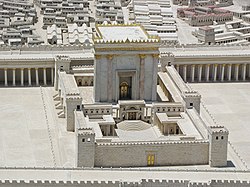
Second Temple
Jewish Temple on the Temple Mount in Jerusalem between c. 516 BCE and 70 CE -

Dohány Street Synagogue
Synagogue in Budapest, Hungary -
.jpg/330px-Old_New_Synagogue_01(js).jpg)
Old New Synagogue
Synagogue in Prague, Czechia
766 places 765 with a point on the map 621 with a date 1 archaeological site
See them on the atlasThe oldest on record
The earliest recorded starts among its best-known places, by 1000 CE, in date order. Each date is the place’s own — a city’s founding, a building’s — not the start of this tradition there.
.jpg/250px-Francois_Vatable%2C_reconstructie_van_de_tempel_van_Salomo_(detail).jpg)


Where they gather
Cities and sites with two or more of its places recorded in them — counted from each place’s own location.
Figures · 528
Who to meet first
The figures its own texts, stories and traditions name — the most widely linked first, this collection’s own before those it shares.
-
.jpg/330px-Seleznikha_church_-_prophet_Moses_(18_c.).jpg) MosesAbrahamic prophet said to have led the Israelites out of Egypt
MosesAbrahamic prophet said to have led the Israelites out of Egypt -
 AbrahamFoundational legendary figure among adherents of the eponymous Abrahamic religions
 -
 MaryMother of Jesus Christ
 -
 SolomonKing of Israel and son of David
 -
 DavidKing of Israel and Judah
 -
 EveThe first woman in the story of Genesis
 -
 NoahBiblical prophet, son of Lamech, major figure in the Book of Genesis
 -
 JacobIn Genesis, a son of Isaac, also known as Israel; the patriarch of the Israelites
 -
.jpg/330px-Mus%C3%A9e_Unterlinden_-_chapiteau_de_l'%C3%A9glise_abbatiale_d'Alspach_-_les_Justes_dans_le_sein_d'Abraham_(XIIe_si%C3%A8cle).jpg) IsaacBiblical character; son of Abraham
IsaacBiblical character; son of Abraham -
 GilgameshSumerian ruler and protagonist of the Epic of Gilgamesh
 -
 Saint JosephChristian saint; husband of Mary and father of Jesus
 -
 ElijahBiblical prophet
More of its best-linked figures
Texts and stories · 144
Stories and texts
What was told, and what was written — dated when it was written.
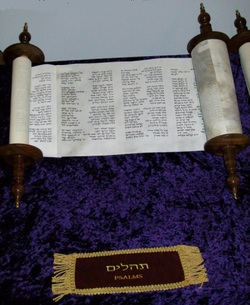
.jpg/250px-Genesis_1_Dead_Sea_Scroll_(Cropped).jpg)



Traditions · 75
Many paths, shared histories
The traditions, schools and movements this collection holds — each with its own page.
-

Judaism
Abrahamic monotheistic ethnic religion of the Jews -
Kabbalah
Esoteric discipline and school of thought, associated with Judaism -
_-_WGA06802.jpg/250px-Duccio_di_Buoninsegna_-_Christ_Accused_by_the_Pharisees_(detail)_-_WGA06802.jpg)
Pharisees
Ancient Jewish sect -

Hasidic Judaism
Religious subgroup of modern Judaism -

Orthodox Judaism
One of the three major Judaism movement, and the formal one in Israel -

Zohar
Work in the literature of Jewish mystical thought known as Kabbalah -
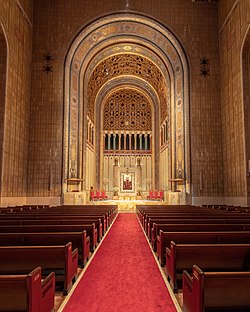
Reform Judaism
Denomination of Judaism -

Conservative Judaism
One of the three major Judaism movements
Festivals and practices · 34
Festivals, holy days and practices
Holy days with the day their record gives, then rites and practices. A festival recurs, so it has no date on the historical clock.
Holy days and festivals · 17, each with the day its record gives
-
 Observed on 15 Nisan and 7 other days
Passover
Jewish holiday celebrating the Israelites' liberation from slavery in Egypt -
 Observed on 25 Kislev and 8 other days
Hanukkah
Jewish holiday -
 Observed on 10 Tishrei
Yom Kippur
Primary holy day in Judaism, tenth day of the new year -
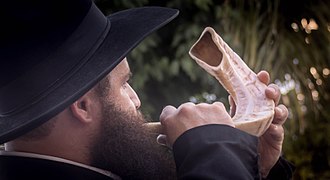 Observed on 1 Tishrei and 1 other day
Rosh Hashanah
Jewish day of judgement preceding Yom Kippur (day of atonement), one of several Jewish New Years -
 Observed on 15 Tishrei and 6 other days
Sukkot
Jewish holiday, harvest festival, festival of booths -
 Observed on 14 Adar
Purim
Jewish holiday and tradition, celebrated on the fourteenth day of the month Adar -
 Observed on 6 Sivan
Shavuot
Jewish holiday, the second of Three Pilgrimage Festivals -
 Observed on 9 Av
Tisha B'Av
Jewish day of fasting
9 more with a recorded day — the full list.
Rites and practices · 13, with no day on record
-

bar and bat mitzvah
Jewish coming-of-age rituals -

Queen of Heaven
Christian devotion of Mary -
.jpg/250px-BethinAZ_-_10-13.002_(by).jpg)
Rosh Chodesh
First day of each Hebrew month -
Tenth of Tevet
Fast day in Judaism -
Jewish holiday
Traditional Jewish holiday -
Three Pilgrimage Festivals
Three major festivals in Judaism
7 more — the full list.
Festivals, practices and events follow how densely Wikidata records them, not how much a tradition keeps: 77% of the 845 held across the collections are Christian, and this collection holds 34.
Institutions, offices and houses · 120
Institutions, offices and houses
Recorded in this collection, the most widely linked first. An office is a line of holders, not a family. A ruling house’s affiliation is the family’s, not its subjects’ practice.
- Institution
Jewish people
Ethnoreligious group and nation from the Levant -
 Office
rabbi
Teacher of Torah in Judaism - Institution
Ashkenazi Jews
Jewish diaspora of Central, Western and Eastern Europe -
 House
HouseRothschild family
Family descending from Mayer Amschel Rothschild -
 House
HouseHasmonean dynasty
Dynasty of the Judean region (140–37 BCE) -
 Office
kohen
Hereditary priest in Judaism, descendant of Aaron
Gods · 8
The gods
The most widely linked across Wikipedia, this collection’s own first. A picture of a god is a work of art, never a likeness.
-
 YahwehNational god of ancient Israel and Judah kingdoms, god of monotheistic Judaism and Abrahamic religions
 -
 ElohimHebrew divine name used in the Tanakh
 -
 God in JudaismJewish conception of God
 -
 El ShaddaiOne of the names of the God of Israel
 -
.jpg/330px-Spas_vsederzhitel_sinay_(cropped1).jpg) Jesus ChristCentral figure of Christianity (c. 6 or 4 BC – AD 30 or 33)
Jesus ChristCentral figure of Christianity (c. 6 or 4 BC – AD 30 or 33) -
 Holy WisdomAttribute of God in Jewish and Christian theology
What this collection holds
Counted, not scored. Each count opens its list.
A record can be more than one kind — a monastery is a place and an institution — so these counts add up to more than its 1,562 records. The sections above count the same way, and draw each record once, under the kind its own page is filed under.
- Statements
- 6,759
- With references
- 1,357
- Undated
- 550
- Accounts
- 0
- Reviewed here
- 0
What it is missing, and how it was assembled
What this collection is missing
Written by an editor, not computed. A count of records cannot say any of this, and a collection read without it is a collection read wrongly.
- Rabbinic transmission is long and well documented in the sources and poorly recorded in structured data.
- Biblical figures carry narrative time and no historical date; where a date appears it is a source's.
- Movement affiliation after 1800 is recorded unevenly.
Counted across the collections
Festivals, practices and events follow how densely Wikidata records them, not how much a tradition keeps: 77% of the 845 held across the collections are Christian, and this collection holds 34.
What the counts mean
- Statements
- Relationships and facts recorded on these records.
- With references
- Statements that cite a source outside Wikimedia.
- Undated
- Records with no date on any of the three clocks.
- Accounts
- Named versions of a story, kept apart.
- Reviewed here
- Read by a person and signed with a date.
How it was assembled
Discovered from Wikidata by class and by religion, ranked by incoming links, then filtered against each item’s own claims. Relationships are imported statements unless a row says otherwise; none of them has been read here.
“Reviewed” means a person read it and signed it with a date — which is why it is zero. Nothing here measures how good the material is.
Records here have an article in 16 languages between them. The interface is English only for now. Published 2026-09-25.
How 271 of these records were placed here through another record
Most records are in Judaism by their own statements. These are here because of another record they are linked to — worked out when the data was built, not stated on the record itself. Each one’s own page says the same.
Cities and sites, through the places recorded in them · 3
Tombs, through the figures buried in them · 3
- Rachel's Tomb — it is the burial place of Rachel
- Nabi Shu'ayb — it is the burial place of Elisha ben Abuyah
- Ohel — it is the burial place of Menachem Mendel Schneerson
Figures and stories, through the text they appear in · 213
- Adam — it appears in Torah
- Eve — it appears in Book of Genesis
- Noah — it appears in Nevi'im
- Isaac — it appears in Book of Genesis
- Queen of Sheba — it appears in Nevi'im
- Gilgamesh — it appears in Book of Giants
and 207 more
Parts, through the whole they belong to · 51
- Ten Commandments — it is part of Exodus 20
- Ecclesiastes — it is part of Ketuvim
- Book of Ruth — it is part of Ketuvim
- Song of Songs — it is part of Ketuvim
- Proverbs — it is part of Ketuvim
- Book of Daniel — it is part of Ketuvim
and 45 more
Works, through their main subject · 1
- Pardes Rimonim — its main subject is Kabbalah


Keep going
Walk Judaism another way.
A family tree as the accounts give it, every mapped place on the atlas, and the dates on the timeline — each on its own clock.