

Tradition collection 1,007 records
East Asian traditions
Daoism, Confucian practice, Chinese folk religion, Shinto and Korean tradition.
- Extent China, Japan, Korea, Vietnam and the diaspora, roughly 1200 BCE to the present.
- Holds 436 places · 420 gods · 83 traditions · 57 figures
Before you count
Whether a given practice is 'a religion' is a live argument in this group, and this site does not settle it.
Places · 436
Holy places and sites
Temples, tombs, holy cities and sites recorded in this collection, the most widely linked first. A place is not a count of believers.
-

Mount Fuji
Volcano in Yamanashi and Shizuoka Prefectures, Japan -

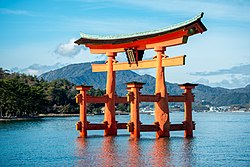
Itsukushima Shrine
Shinto shrine in Hiroshima Prefecture, Japan -

Nikkō-shi
City in Tochigi prefecture, Japan -

Ise
City in Mie prefecture, Japan -
.jpg/330px-2018_Haiden_(Yasukuni_Shrine).jpg)
Yasukuni Shrine
Shinto shrine in Tokyo, Japan -

Ise Jingū
Shinto shrine in Mie Prefecture, Japan -

Mount Ontake
Mountain in Nagano and Gifu Prefectures, Japan -

Fushimi Inari-taisha
Shinto shrines in Kyoto, Japan -

Tenri
City in Nara prefecture, Japan
436 places 436 with a point on the map 244 with a date
See them on the atlasThe oldest on record
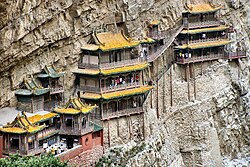
The earliest recorded starts among its best-known places, by 1000 CE, in date order. Each date is the place’s own — a city’s founding, a building’s — not the start of this tradition there.




Where they gather
Cities and sites with two or more of its places recorded in them — counted from each place’s own location.
Gods · 420
The gods, and the company they keep
The most widely linked across Wikipedia, this collection’s own first. A picture of a god is a work of art, never a likeness.
-
 AmaterasuSun goddess in Shinto
 -
 SusanooShinto deity
 -
 IzanagiDeity of Shinto religion
 -
 NüwaLegendary figure of Chinese prehistory, the sister and wife of Fuxi and variously described as a divine mother goddess, half-snake demigod, empress and inventor
 -
 Jade EmperorThe highest god of many Taoist sects, overseeing the universe through administration of a celestial bureaucracy mirroring ancient and medieval China's
 -
 Chang'eChinese mythical figure
 -
 InariJapanese kami of foxes, of fertility, rice, tea and Sake, of agriculture and industry etc
 -
 MazuChinese sea goddess
 - IzanamiGoddess of Shinto religion
-
 Ame no UzumeGoddess of Kagura
 -
 HachimanJapanese Shinto–Buddhist syncretic deity of archery and war; tutelary god of warriors; protector of Japan, the Japanese people and the Imperial House; the name means "God of 8 Banners", after the 8 heavenly banners signaling the birth of Ōjin Tennō
 -
 Hou YiChinese mythological archer
More of its best-linked gods
In company
Pantheons, read from the members’ own records — never from a fixed roster.
Eight Immortals 8 members on record Explore the pantheon
-
 Lü DongbinChinese Taoist scholar and poet during the Tang Dynasty
 -
 Immortal Woman HeOne of the Eight Taoist Immortals
 -
 Imperial Uncle CaoSong dynasty person (CBDB = 16846)
 -
 Lan CaiheChinese mythological figure
 -
 Elder Zhang GuoChinese mythological figure
 -
 Han XiangOne of the Eight Taoist Immortals
 -
 Iron-Crutch LiTaoist mythological figure
 -
 Zhongli QuanChinese mythological figure, one of the Eight Immortals of the Taoist pantheon


.jpg/120px-Ping_Sien_Si_-_129_Wenshu_Guang_Fa_Tianzun_(16758454421).jpg)
.jpg/120px-Ping_Sien_Si_-_049_Pu_Xian_Zhenren_(16140594543).jpg "Picture: lead image of the English Wikipedia article")



_(cropped).jpg/120px-Statue_of_Guanyin%2C_February_5%2C_2019_(3)_(cropped).jpg)


Traditions · 83
Many paths, shared histories
The traditions, schools and movements this collection holds — each with its own page.
-
_(1).jpg/250px-Taoist_ceremony_at_Xiao_ancestral_temple_in_Chaoyang%2C_Shantou%2C_Guangdong_(daoshi)_(1).jpg)
Taoism
Religious or philosophical tradition of Chinese origin -

Confucianism
Chinese ethical and philosophical system -
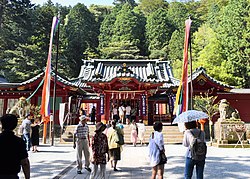
Shinto
A polytheistic and animistic religion originating in Japan -

Chinese folk religion
Traditional Han Chinese religious belief systems -

Cheondoism
20th-century Korean pantheistic religion, based on the 19th-century Donghak religious movement founded by Choe Je-u and codified under Son Byong-hi -

Korean shamanism
Folk religion of the Korean Peninsula -
.jpg/250px-White_Lotus_Society_(cropped).jpg)
White Lotus
Religious and political movement -

Quanzhen School
School of Taoism founded by Wang Chongyang in 12th century Shandong during the Jin dynasty
Figures · 57
Who to meet first
The figures its own texts, stories and traditions name — the most widely linked first, this collection’s own before those it shares.
-
 Confucius5th-century BCE Chinese philosopher and politician
 -
.jpg/330px-Zhang_Lu-Laozi_Riding_an_Ox_(cropped).jpg) Laozi6th-century BC semi-legendary Chinese philosopher, founder of Taoism
Laozi6th-century BC semi-legendary Chinese philosopher, founder of Taoism -
 Zhang DaolingLegendary Han dynasty Chinese Taoist leader, grandfather of Zhang Lu
 -
 Qiu ChujiFounder of the Longmen school of Quanzhen Taoism
 -
 Zhang JueChinese Yellow Turban Rebellion leader (died 184)
 -
 Abura-sumashiJapanese folklore
 -
 Wang ChongyangChinese Taoist (1113–1170) who founded the Quanzhen school of Taoism
 -
 Yamazaki AnsaiJapanese philosopher
 -
 En no GyōjaLegendary founder of Shugendō
 -
 HirohitoEmperor of Japan from 1926 to 1989
 -
.jpg/330px-Emperor_Akihito_(2016).jpg) AkihitoEmperor of Japan from 1989 to 2019
AkihitoEmperor of Japan from 1989 to 2019 -
 Emperor MeijiEmperor of Japan from 1867 until 1912
More of its best-linked figures
Texts and stories · 15
Stories and texts
What was told, and what was written — dated when it was written.
-
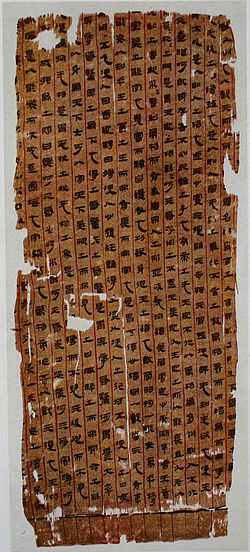 Text
TextTao Te Ching
Chinese classic text -
.png/250px-Shinpukuji-bon_Kojiki_(%E7%9C%9F%E7%A6%8F%E5%AF%BA%E6%9C%AC%E5%8F%A4%E4%BA%8B%E8%A8%98).png) Text
TextKojiki
8th-century Japanese chronicle -
 Text
TextInvestiture of the Gods
16th-century Chinese novel -
 Text
TextBaopuzi
Taoist text by Ge Hong -
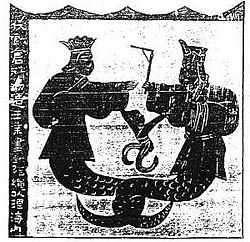 Story
StoryChinese creation myth
Narratives about the origins of the world from Chinese folklore -
_c1870_after_Kawanabe_Kyosai.jpg/250px-Installation_of_the_Sun_Goddess_(Amaterasu)_c1870_after_Kawanabe_Kyosai.jpg) Story
StoryJapanese creation myth
Japanese mythology about the creation of the world and of Japan
Institutions, offices and houses · 420
Institutions, offices and houses
Recorded in this collection, the most widely linked first. An office is a line of holders, not a family. A ruling house’s affiliation is the family’s, not its subjects’ practice.
-
 House
HouseJoseon
Korean dynasty / kingdom (1392–1897) -
 House
HouseImperial House of Japan
Members of the extended family of the reigning Emperor of Japan - House
Nguyen dynasty
Imperial Vietnamese dynasty, 1802-1945 -
 House
HouseLy dynasty
Vietnam's monarch that ruled from 1009 to 1226. -
 House
HouseWestern Han
The first half of the Han dynasty of imperial China -
 House
HouseTran dynasty
Imperial Vietnamese dynasty (1225–1400)
Festivals and practices · 12
Festivals, holy days and practices
Holy days with the day their record gives, then rites and practices. A festival recurs, so it has no date on the historical clock.
-

neidan
Esoteric doctrines and physical, mental, and spiritual practices in Taoism -

Cheung Chau Bun Festival
Folk festival on the island of Cheung Chau in Hong Kong, a Taoist ritual event -

gut
Korean ritual -

Katsuragi 28 Shuku
Sutra mounds in Kansai region, Japan -
Taoist meditation
Associated with the Chinese philosophy and religion of Taoism -
bigu
Daoist's or Shugenja's fasting technique associated with achieving transcendence/immortality, avoiding grain
1 more — the full list.
Festivals, practices and events follow how densely Wikidata records them, not how much a tradition keeps: 77% of the 845 held across the collections are Christian, and this collection holds 13.
Also here · 1
Also in this collection
Kinds it holds only one or two of, each with its own page.

What this collection holds
Counted, not scored. Each count opens its list.
A record can be more than one kind — a monastery is a place and an institution — so these counts add up to more than its 1,007 records. The sections above count the same way, and draw each record once, under the kind its own page is filed under.
- Statements
- 3,597
- With references
- 384
- Undated
- 690
- Accounts
- 0
- Reviewed here
- 0
What it is missing, and how it was assembled
What this collection is missing
Written by an editor, not computed. A count of records cannot say any of this, and a collection read without it is a collection read wrongly.
- Whether a given practice is 'a religion' is a live argument in this group, and this site does not settle it.
- Local shrine deities in Japan and China number in the tens of thousands; a few hundred are recorded.
- Daoist canon dating is compiled and re-compiled, so a text's date is the edition's more often than the composition's.
Counted across the collections
Festivals, practices and events follow how densely Wikidata records them, not how much a tradition keeps: 77% of the 845 held across the collections are Christian, and this collection holds 13.
What the counts mean
- Statements
- Relationships and facts recorded on these records.
- With references
- Statements that cite a source outside Wikimedia.
- Undated
- Records with no date on any of the three clocks.
- Accounts
- Named versions of a story, kept apart.
- Reviewed here
- Read by a person and signed with a date.
How it was assembled
Discovered from Wikidata by class and by religion, ranked by incoming links, then filtered against each item’s own claims. Relationships are imported statements unless a row says otherwise; none of them has been read here.
“Reviewed” means a person read it and signed it with a date — which is why it is zero. Nothing here measures how good the material is.
Records here have an article in 16 languages between them. The interface is English only for now. Published 2026-09-25.
How 26 of these records were placed here through another record
Most records are in East Asian traditions by their own statements. These are here because of another record they are linked to — worked out when the data was built, not stated on the record itself. Each one’s own page says the same.
Cities and sites, through the places recorded in them · 4
Places, through the god they are dedicated to · 8
- Thean Hou Temple — it is dedicated to Mazu
- Ōsaka Tenmangū — it is dedicated to Tenjin
- Sasuke Inari Shrine — it is dedicated to Ukanomitama
- Suitengū — it is dedicated to Ame-no-Minakanushi
- Nishiki Tenmangū — it is dedicated to Tenjin
- Amanawa Shinmei Shrine — it is dedicated to Amaterasu
and 2 more
Parts, through the whole they belong to · 5
- Imperial Uncle Cao — it is part of Eight Immortals
- Lan Caihe — it is part of Eight Immortals
- Elder Zhang Guo — it is part of Eight Immortals
- Han Xiang — it is part of Eight Immortals
- Iron-Crutch Li — it is part of Eight Immortals
Works, through their main subject · 5
- Tao Te Ching — its main subject is Lao–Zhuang school
- Investiture of the Gods — its main subject is Taoism
- Baopuzi — its main subject is Taoism
- Zhengao — its main subject is Shangqing School
- Divine Incantations Scripture — its main subject is Way of the Celestial Masters
Pantheons, through their own published gods · 4
- Seventeen Generations of Earthly Deities — 6 of its 6 published gods are in this collection
- Chijin Godai — 5 of its 5 published gods are in this collection
- Three generations of Hyuga — 3 of its 3 published gods are in this collection
- Five House Gods — 4 of its 5 published gods are in this collection


Keep going
Walk East Asian traditions another way.
A family tree as the accounts give it, every mapped place on the atlas, and the dates on the timeline — each on its own clock.