

Gods Traditions Places
Every belief
has a history.
Gods, traditions, stories and sacred places from around the world, and how they connect — each link labelled with its kind and its source.
Every god, every story,
every sacred place —
each in its own account.
Sources named, always
Divine families
A closer look at a divine family
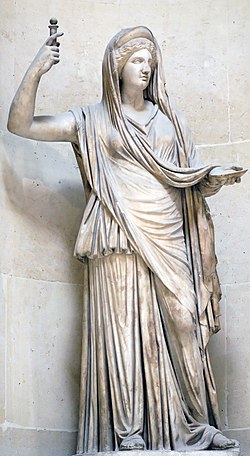
Zeus’s family, as the accounts tell it.
Parents above, Hera beside him and their children below. The records give Zeus 75 consorts and 163 children; his page opens each consort’s children in turn.
Open the family tree


.jpg/250px-%CE%9F_%CE%86%CF%81%CE%B7%CF%82_(Borghese-%CE%9B%CE%BF%CF%8D%CE%B2%CF%81%CE%BF%CF%85).jpg)


Across cultures. Across time.
Six of 18 collections. Each one says what it holds, and what it is missing.
-

Christianity
Its branches, councils, saints, offices and buildings — and where they stopped recognising each other. -

Ancient Egypt
Three thousand years of gods whose names, forms and relationships changed with the dynasty and the city. -
.jpeg/330px-UgrataraTemple2_(cropped).jpeg)
South Asian traditions
Hinduism and its schools, Jainism, Sikhism, and the Vedic material behind them. -

Greek and Roman
The Olympians and their Roman equivalents, the mystery cults, and the poets whose accounts disagree. -

Buddhist traditions
Theravāda, Mahāyāna and Vajrayāna, their figures, sutras, lineages and monasteries. -

Islam
Schools of law and theology, the scholars who transmitted them, and the places they taught.
Four thousand gods, one index.
4,089 deities from 18 collections, in one index. Search by name, or start with a face.


_MQ-3.jpg/330px-20041229-Coatlicue_(Museo_Nacional_de_Antropolog%C3%ADa)_MQ-3.jpg)


Festivals and turning points
Holy days recur, so they carry no date; 459 of 513 events are dated.
Kept every year


Dated on the record
- 184 CE – 205 CE Yellow Turban Rebellion Rebellion against corruption of the Imperial Court rooted in Taoist religious principles

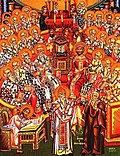
- 325 CE First Council of Nicaea Council of Christian bishops in Nicaea, 325
- 1095 CE – 1291 CE Crusades Mass military expeditions and wars initiated by the Catholic Church in the High Middle Ages

- 1517 CE – 1648 CE Protestant Reformation 16th-century movement in Western Christianity

81% of the events on record are in the Christian collection, following what Wikidata holds. All 513 events, by date
A longer view
Five ages, counted on the historical clock — not by source or story dates.
- Bronze Age c. 3200 BCE – 1200 BCE 45 figures · 2 traditions · 43 sites
- Antiquity c. 1200 BCE – 500 CE 601 figures · 46 traditions · 277 sites
- Medieval c. 500 CE – 1500 CE 2,565 figures · 93 traditions · 2,468 sites
- Early modern c. 1500 CE – 1800 CE 1,609 figures · 104 traditions · 1,234 sites
- Modern c. 1800 CE – present 1,819 figures · 963 traditions · 1,586 sites


.jpg/120px-Spas_vsederzhitel_sinay_(cropped1).jpg)

.jpg/120px-Buddha_in_Sarnath_Museum_(Dhammajak_Mutra).jpg)

.jpg/120px-Lucas_Cranach_d.%C3%84._-_Martin_Luther%2C_1528_(Veste_Coburg).jpg)


Sacred places
8,160 sacred places and 380 archaeological sites on record; 8,538 of them on the atlas.

.jpg/330px-Hamandir_Sahib_(Golden_Temple).jpg)


Guided journeys
A note at every step. The first is free.
-
 Free · 7 steps
From Zeus to Jupiter
A Greek god, a Roman god, and the old habit of calling one by the other’s name — followed from the records to the symbols to the places where each was worshipped. -
.png/250px-Shinpukuji-bon_Kojiki_(%E7%9C%9F%E7%A6%8F%E5%AF%BA%E6%9C%AC%E5%8F%A4%E4%BA%8B%E8%A8%98).png) Plus
7 steps
Plus
7 stepsThe sun goddess and a claimed descent
Two eighth-century chronicles, a sun goddess, and a royal house that traces itself to her — and why a descent claimed in an account is never drawn as a documented family. -
 Plus
5 steps
Plus
5 stepsA king pays for a religion
Ashoka, Buddhism and the Mauryan state — four different claims that a single sentence usually merges into one, taken apart.
Free to read. Plus to go further.
Every page is free. Plus opens the whole map of belief.
Beliefs is part of the HistorIQly membership — the same Plus that opens the Map, the Timeline, Dynasties and the Books library.
Free
- Every god, tradition, story and place — all 26,567 pages
- Each subject’s immediate family, drawn: parents, consorts, children
- The atlas of sacred places, 3000 BCE to 400 CE
- The first guided journey, start to finish
Plus
- Every generation. Open a family as far as the record goes, and re-centre it on anyone in it
- Every century. The atlas past 400 CE, with every layer
- Every journey. All 10 guided journeys
You have Plus. Everything here is open.
Honest about the evidence
What this site is careful about
- Every relationship says what kind it is A parentage in a poem, a family, an office and a teacher are four claims, drawn four ways.
- Three clocks, never one When it happened, when it was written, and when it happens in the story.
- Sites, not believers A pin on the atlas is a place; no religion is painted over a people.
- Counted, not scored Each collection says what it holds and what it is missing.
- Nothing asked of you Saving and your history stay in this browser. No one asks what you believe.